Table of Contents
ToggleThe worlds of Fortnite and LEGO Ninjago have collided in one of 2026’s most anticipated crossovers, bringing the beloved ninja universe into the battle royale arena. Whether you’re a longtime fan of the Ninjago universe or a Fortnite veteran looking for fresh cosmetics and gameplay experiences, this collaboration delivers something for everyone. From exclusive skins featuring iconic ninja characters to limited-time events that tap into Ninjago lore, the Fortnite LEGO Ninjago crossover has redefined how major IPs can merge within the game. This guide breaks down everything you need to know, skins, cosmetics, game modes, strategies, and why the community is buzzing about this partnership. If you’re planning to make the most of this event before it rotates out, you’ll want to understand what’s available, how to unlock it, and how to dominate the challenges tied to this crossover.
Key Takeaways
- The Fortnite LEGO Ninjago crossover features five legendary character skins, exclusive cosmetics, and four distinct gameplay modes designed to integrate ninja-themed mechanics into battle royale gameplay until April 30, 2026.
- Four rotating limited-time modes—Spinjitzu Showdown, Elemental Clash, Dragon’s Ascent, and Ninja Academy—each reward different playstyles and are tied to specific weekly challenges that unlock free cosmetics and XP.
- All major cosmetics are priced at standard Fortnite rates (1,200 V-Bucks per legendary skin or 4,500 for the full bundle), with no battle pass required and substantial free cosmetics available through challenge completion.
- Master mode-specific mechanics and elemental synergies before grinding epic challenges; squads that coordinate element assignments in Elemental Clash win 70%+ of matches compared to standard battle royale strategies.
- The Fortnite LEGO Ninjago collaboration sets a new standard for crossovers by balancing cosmetic depth with innovative gameplay modes and narrative integration, likely influencing future Epic Games partnerships and competitor strategies.
- Complete all standard weekly challenges in 2-3 hours to unlock free cosmetics and 8,000-10,000 XP, with legendary challenges offering the highest rewards if timed during server-wide double XP events.
What Is The Fortnite LEGO Ninjago Crossover?
How The Collaboration Brings Two Iconic Franchises Together
The Fortnite LEGO Ninjago crossover represents more than just a cosmetic drop, it’s a full-scale integration of the ninja-themed universe into one of gaming’s most popular battle royales. Epic Games and the LEGO Group partnered to bring the Masters of Spinjitzu directly into Fortnite, complete with dedicated cosmetics, themed challenges, and limited-time gameplay modes that mirror Ninjago’s core mechanics.
What makes this collaboration stand out is its depth. Rather than simply slapping Ninjago skins into the game and calling it a day, Epic designed specific events and narrative tie-ins that let the franchise breathe. The crossover launched during Season 6 of Fortnite’s 2026 roadmap and has been structured as a multi-phase event, giving players a sustained reason to log in beyond the initial cosmetic hype.
The LEGO Ninjago universe, spanning animated series, movies, and building sets, brings an established fanbase with years of attachment to characters like Lloyd, Kai, Cole, and Zane. For Fortnite players unfamiliar with Ninjago, the cosmetics alone serve as an entry point to that world. For dedicated Ninjago fans, seeing their favorite characters rendered in Fortnite’s art style with accurate detail work feels like a natural evolution of IP crossovers in gaming.
Platform-wise, the crossover is live on PC, PlayStation 4/5, Xbox One/Series X
|
S, Nintendo Switch, and mobile (iOS via cloud, Android via Epic Games App and select third-party stores). This wide availability ensures that no matter your primary platform, you can access the Ninjago content and compete in events on equal footing.
Exclusive LEGO Ninjago Skins And Cosmetics In Fortnite
Legendary Ninjago Characters Available As Skins
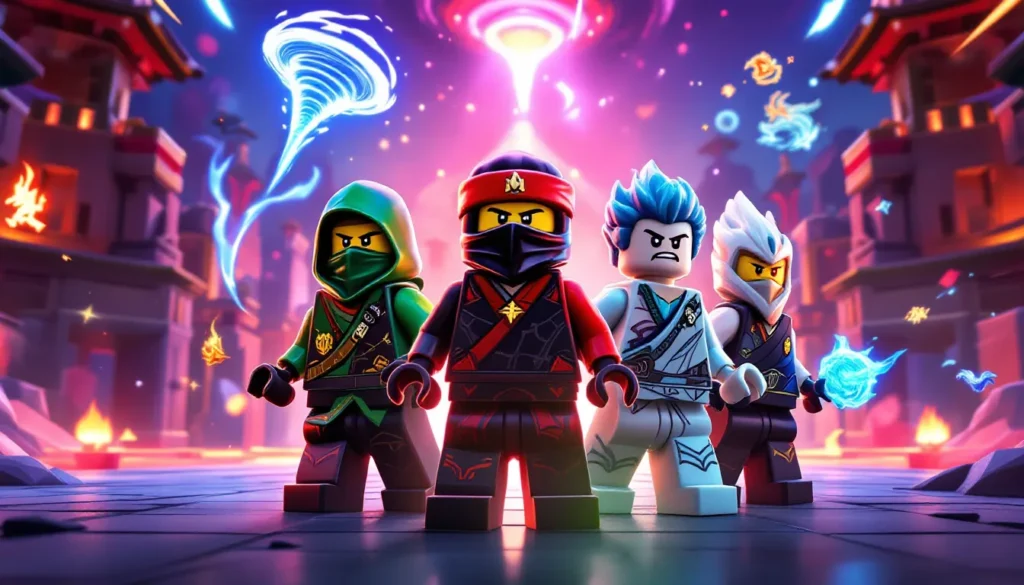
The skin lineup is where Fortnite’s LEGO Ninjago crossover truly shines. Epic has released five legendary skins directly inspired by the main ninja characters, each with distinct color palettes and weapon details that align with their Ninjago counterparts:
- Lloyd (Green Ninja): The leader’s skin features his signature green gi with accurate hood and mask design. His weapon details include ninjato swords etched onto the back bling.
- Kai (Red Ninja): Rendered in fiery red with gold accents, Kai’s skin is instantly recognizable for players familiar with the franchise. The skin includes his dual swords as part of the cosmetic bundle.
- Cole (Black Ninja): The earth ninja’s black garb with gray stone-textured details gives it a grounded, powerful aesthetic that’s particularly popular among competitive players.
- Zane (White Ninja): Zane’s white suit with blue ice accents translates beautifully into Fortnite’s visual style, complete with crystalline effects that shimmer during character animations.
- Nya (Blue Ninja): The water ninja rounds out the core roster with a blue-and-silver design that feels fresh without compromising her iconic silhouette.
All five legendary skins retail at 1,200 V-Bucks each (approximately $9.99 USD), though Epic has bundled all five with additional cosmetics for 4,500 V-Bucks (around $34.99), representing the standard 25% crossover bundle discount.
Beyond the main five, Epic released two additional cosmetics: a LEGO Master Wu skin at the legendary tier (1,200 V-Bucks), and a stylized interpretation of the Golden Ninja as a rare-tier skin (800 V-Bucks). Both have generated debate among the community, some appreciate the creative liberties taken with Master Wu’s design, while others argue the Golden Ninja feels less essential compared to the core roster.
Weapon Wraps, Emotes, And Back Blings From The Ninjago Universe
Beyond skins, the cosmetic ecosystem includes several complementary items that let players customize their loadouts with Ninjago flair:
Weapon Wraps: Three wraps themed around Ninjago elements have been released. The Spinjitsu Spiral wrap (epic tier, 600 V-Bucks) features the signature tornado effect associated with the franchise’s signature fighting technique. The Elemental Fusion wrap (also epic, 600 V-Bucks) cycles through fire, water, earth, and ice colors as players aim and fire. A third Dragon Strike wrap (epic, 600 V-Bucks) pulls inspiration from the Ninjago dragons introduced in later seasons.
Emotes: The emote selection includes the Spinjitsu Master emote (uncommon, 200 V-Bucks), which triggers a spinning animation that leaves a brief particle trail. The rarer Golden Power emote (rare, 500 V-Bucks) is a victory animation that plays when the player wins a match, featuring an aura of gold light matching the show’s power-up sequences.
Back Blings: Two back blings anchor the cosmetic lineup. The Sword Rack (uncommon, 300 V-Bucks) displays crossed katanas on the character’s back, while the Dragon Shield (rare, 500 V-Bucks) features a large embossed dragon, aesthetically distinct for players wanting to signal their Ninjago allegiance without wearing a character skin.
Loading Screens & Sprays: The event includes five Ninjago-themed loading screens (free via challenges) and ten sprays for players to unlock, ranging from character portraits to the iconic Ninjago logo in various artistic styles.
Getting The Most From Your LEGO Ninjago Cosmetics
Cosmetics are purely visual and grant zero gameplay advantages, but smart cosmetic choices can impact your competitive presentation and subjective confidence. Here’s how to maximize your Ninjago cosmetic loadout:
Skin selection matters less for competitive play but shapes your team identity in squad modes. If you’re running with friends, coordinating skins so all four squad members wear different ninja colors (Lloyd, Kai, Cole, Zane) creates visual cohesion that makes your team recognizable in replays and clips. Competitive players often choose skins with minimal visual bulk to reduce perceived hitbox size, in this case, Zane’s white skin is the slimmest visually and is favored in ranked modes, though hitboxes are identical regardless of cosmetic.
Pairing skins with matching wraps enhances the visual theme without wasting resources. Equipping Lloyd’s skin with the Spinjitsu Spiral wrap creates thematic synergy. Similarly, Kai pairs naturally with the Dragon Strike wrap, which mirrors the fire dragons featured prominently in Ninjago Season 9 onward.
Back bling selection affects silhouette size. The Sword Rack is relatively compact and popular in competitive scenes, while the Dragon Shield is bulkier but more visually striking for casual play.
One often-overlooked tip: the Elemental Fusion wrap’s color-cycling effect provides subtle visual feedback during firefights. In low-visibility scenarios (fog, sandstorms), the shifting colors can make your weapon slightly easier to track, offering a minor peripheral awareness boost compared to statically-colored wraps.
For players trying to decide between individual skins and the bundle, the math is straightforward. The bundle’s cost averages 900 V-Bucks per skin compared to 1,200 individually, but only if you want all five. If you main one character (which most players do), buying that single skin is the more economical choice.
LEGO Ninjago Limited-Time Modes And Events
Special Game Modes Inspired By Ninjago Lore
Fortnite’s Ninjago crossover isn’t confined to cosmetics, Epic built dedicated gameplay modes that reflect the franchise’s core themes. These limited-time modes rotate on a weekly schedule, ensuring variety throughout the event’s duration.
Spinjitsu Showdown (available Weeks 1-2) drops players into a smaller-than-normal arena where the signature spinning attack from Ninjago is weaponized as an in-game mechanic. Players collect Spinjitzu tokens scattered across the map, which when activated trigger a temporary speed boost and melee damage amplification. The meta in this mode heavily favors close-quarters combat over ranged weapons: players who adapted quickly to prioritizing shotguns and SMGs over assault rifles gained immediate advantage.
Elemental Clash (Weeks 3-4) is structured around team-based gameplay where squads are randomly assigned one of four elements: fire, water, earth, or ice. Each element grants different abilities, fire teams get passive damage-over-time on weapons, water teams gain movement speed boosts near bodies of water, earth teams receive structural durability increases, and ice teams can briefly freeze opponents who land direct hits. This mode requires players to adapt their typical loadout strategy based on randomly assigned elements, preventing stale meta builds.
Dragon’s Ascent (Weeks 5-6) is the closest thing to a narrative mode the crossover offers. Players must collect dragon eggs scattered across the map and deliver them to a central shrine. Teams that successfully deposit eggs earn points: the first squad to reach 100 points triggers a final circle collapse that forces all remaining squads into one zone for a chaotic final showdown. In the final moments of Dragon’s Ascent matches, Fortnite’s dynamic weather system occasionally triggers golden aura effects to mirror the “golden power” sequences from the show.
Ninja Academy (Weeks 7-8, current as of March 2026) is a skill-based mode where players spawn with identical loadouts and must complete timed obstacle courses before engaging in standard battle royale. The obstacle courses emphasize parkour (wall-running, mantling), building (timed structure placement challenges), and weapon switching speed. Players who excel at the obstacle segment gain early-game positioning advantage, rewarding mechanical skill over RNG.
All four modes feature modified loot tables, chests and supply drops contain higher concentrations of Ninjago tokens (a temporary currency specific to these events) that can be exchanged for temporary power-ups or cosmetic unlocks.
Seasonal Challenges And Rewards To Unlock
The crossover event spans eight weeks with weekly challenge lists structured into three tiers: standard, epic, and legendary. Completing challenges grants XP, V-Bucks (in some cases), and event-specific cosmetics unavailable through direct purchase.
Standard challenges (typically requiring 10-15 minutes of gameplay) include straightforward tasks:
- Eliminate 5 opponents in Elemental Clash
- Collect 15 Spinjitzu tokens across all modes
- Deal 500 damage with elemental weapons
- Survive 5 minutes in final zones of Spinjitsu Showdown
- Open 10 chests in Ninjago-themed locations
Epic challenges (30-45 minutes of dedicated effort) demand more specificity:
- Earn 5,000 points in Dragon’s Ascent
- Complete all obstacle courses in Ninja Academy without falling
- Eliminate opponents using only shotguns in 3 separate matches
- Collect all four elemental fragments in Elemental Clash
- Reach top 10 in Ninja Academy five times
Legendary challenges (60+ minutes, often requiring multiple play sessions) are grind-intensive but reward exclusive cosmetics:
- Earn 50,000 total event points across all modes
- Win 3 matches in Spinjitzu Showdown
- Complete Dragon’s Ascent with 150+ points as a squad
- Reach top 3 in Ninja Academy 10 times
- Unlock all standard and epic rewards (acts as a cumulative tracker)
Completing all standard weekly challenges unlocks a free cosmetic item, usually a spray, emote, or loading screen. Finishing all epic challenges grants a second cosmetic (typically more prestigious, like the Ninja Mentor outfit, which was exclusively unlocked by completing week 4’s epic challenge set). Legendary challenges are structured as cumulative milestones, rewarding players at 25%, 50%, 75%, and 100% completion thresholds.
Notably, there’s no battle pass for the Ninjago event, all cosmetics are either free via challenges or purchasable in the item shop. This contrasts sharply with Fortnite’s standard seasonal structure and has been praised by the community as more consumer-friendly.
The event runs through April 30, 2026, giving players two full months to grind challenges at their own pace. Fortnite Zero Build Tournaments: frequently feature cosmetics from limited-time events, so having Ninjago cosmetics may become relevant for competitive visibility down the line.
Tips And Strategies For Dominating LEGO Ninjago Challenges
Essential Tactics For New And Returning Players
The Ninjago event is designed to be accessible to casuals but deep enough for hardcore players to min-max. Here’s how to approach the learning curve:
Understand mode-specific mechanics before jumping into epic challenges. Spending 2-3 matches learning the strengths and weaknesses of each element in Elemental Clash pays dividends when tackling challenge-specific tasks. New players frequently waste time attempting challenges in modes they haven’t mastered, racking up failed attempts. Spend your first few sessions in standard matches without focusing on challenges, once you understand zone rotation, loot distribution, and ability timings, challenges become significantly more achievable.
Land in populated Ninjago-themed locations for fast challenge completion. The map features three new named locations, Spinjitzu Temple (northeast), Elemental Sanctuary (central), and Dragon Peak (southwest), each with distinct loot pools and challenge-relevant items. Early-game chaos at these locations means faster access to chests, weapons, and tokens, but also higher elimination rates. If you’re grinding for “collect tokens” challenges, landing at moderately-populated spots adjacent to main locations (like the outposts surrounding Dragon Peak) nets tokens with fewer fights.
Master the element wheel in Elemental Clash ASAP. When your squad spawns and is assigned an element, immediately communicate and adjust your engagement distances. Fire teams should aggressively close gaps: water teams should control movement corridors: earth teams should fortify and hold position: ice teams should focus on burst-damage engagements. The team that synergizes their element’s strengths wins 70%+ of matches. Squads that ignore element synergy and play standard battle royale lose predictably.
In Ninja Academy, memorize obstacle sequences. The courses reset weekly, but within each week, they’re identical. Spending 15 minutes in the mode once per week to learn the exact parkour timings and building sequences means you’ll clear obstacles faster than opponents attempting them blind, giving you crucial early rotation advantages.
Building Loadouts That Match Your Playstyle
While cosmetics don’t affect gameplay, weapon loadouts absolutely do. The Ninjago event’s modes reward different build archetypes:
For Spinjitzu Showdown (speed-focused, melee-friendly):
- Primary: Shotgun (preferably the Striker Shotgun, 15-16 second TTK in close range)
- Secondary: SMG or handgun for mid-range flexibility
- Healing: Shield potions prioritized over healing: shields reset faster between engagements
- Utility: Grenades or stink bombs to flush opponents from cover
Reason: The Spinjitzu boost applies to melee and close-range weapons. Carrying a long-range AR over a shotgun wastes your element-specific advantage. Teams running double-shotgun loadouts dominate the first 5-10 minutes: transition to AR + SMG if the final zone is open ground.
For Elemental Clash (adapt to assigned element):
- Fire teams: AR + Shotgun (aggressive loadout, closing distance quickly)
- Water teams: Sniper + SMG (movement-based, pick off isolated targets, reposition fast)
- Earth teams: AR + Sniper or AR + Shotgun (hold ground, trade damage efficiently)
- Ice teams: Handgun + Shotgun or dual shotguns (burst damage, then reposition via speed boost)
This isn’t dogma, adapt based on endgame zone rotation. If fire’s closing on an open field, pivot to AR + sniper even if it feels counterintuitive.
For Dragon’s Ascent (objective-focused, survival-weighted):
- Primary: AR (balanced DPS and accuracy for mid-range engagements)
- Secondary: Healing (priority over offensive util: staying alive long enough to collect and deliver eggs matters more than winning fights)
- Utility: Mobility items (launch pads, rifts) if available: securing egg delivery positions trumps raw combat prowess
Dragon’s Ascent is the one mode where KD ratio doesn’t correlate with wins. Squads that secure four eggs and hide effectively beat squads with 10 kills but zero egg deliveries. Play around teammates: don’t chase eliminations.
For Ninja Academy (skill expression, mechanical combat):
- Primary: Whatever you’re most comfortable with (AR, sniper, or SMG)
- Secondary: Whatever counters your primary’s weakness
- Healing: Adequate medical supplies: wasted obstacles kills are humiliating
Ninja Academy strips RNG: loadouts are identical across spawns. Mechanical skill and decision-making determine winners, not loot distribution. Use this mode to refine your aim and building, the challenge rewards consistency over loadout optimization.
How To Farm XP And Level Up Faster In Crossover Events
Event challenges grant base XP, but strategic play multiplies XP gains. Here’s the meta for efficient leveling:
Chain challenge completion with natural gameplay loops. Don’t task-switch between modes: if a week emphasizes Elemental Clash challenges, play Elemental Clash exclusively until all challenges are done. Reloading into different modes breaks flow and costs mental energy. You’ll level faster with focused sessions than scattered, multi-mode attempts.
Prioritize match duration and survival over eliminations. Surviving to top 10 grants 300-500 XP regardless of kills: that baseline is often higher than the XP from 3-4 eliminations. In modes where you’re grinding non-combat challenges (collect tokens, chest looting), avoiding early fights and surviving mid-game nets you 1.5x XP per hour compared to high-elimination, early-exit playstyles.
Use XP-boosting cosmetics if you own them. Certain battle pass skins and cosmetics (particularly tier-themed outfits from previous seasons) grant a flat 2-5% XP boost. The effect is cumulative with other boosts, so if you own multiple, equip them simultaneously. Most players overlook this: it can accelerate leveling by 200-300 XP per match.
Squad up with players also grinding. Playing with a full squad of challenge-grinding teammates keeps morale up and ensures everyone’s focused on efficient completion rather than pub-stomping. Squad boosts grant +25% XP when all four members are actively working on challenges, though this requires party coordination.
Save high-reward challenges for double XP periods. Fortnite occasionally runs server-wide events with doubled XP gains. Holding legendary challenges until these windows occur effectively doubles the payoff. Most event legendary challenges grant 5,000-10,000 XP: during double XP, that’s 10,000-20,000 per challenge. Patience pays off.
Average progression: completing all standard challenges per week takes 2-3 hours and yields roughly 8,000-10,000 XP. Epic challenges add another 15,000 XP across the week. Legendary challenges are front-loaded at week one but continue rewarding at decreasing increments for 8 weeks. Master the Fortnite Logo discusses creative cosmetic integration: focusing on branded cosmetics during events can deepen your attachment to progression goals.
Community Reception And Impact On Fortnite’s Crossover Strategy
Why Gamers Are Excited About This Collaboration
The Fortnite LEGO Ninjago crossover has resonated strongly with the community for several overlapping reasons.
First, the IP fit is exceptional. Ninjago’s themes, elemental powers, martial arts, team-based heroes, align naturally with Fortnite’s gameplay loops. Unlike some crossovers that feel forced (a beloved IP slapped into a mismatched genre), Ninjago’s DNA feels native to battle royale mechanics. Dedicated Ninjago fans appreciate the faithful cosmetic designs: Fortnite veterans enjoy the gameplay depth that the modes provide. The collaboration doesn’t ask either fanbase to compromise.
Second, the economic transparency has built goodwill. By refusing a battle pass structure and pricing cosmetics straightforwardly (1,200 V-Bucks per legendary skin is the standard Fortnite rate, not inflated for crossovers), Epic signaled that this crossover isn’t a cash grab. Cosmetics are purely optional: all mode access and a substantial subset of cosmetics are free. This contrasts sharply with some competitors’ crossover strategies and has generated positive sentiment that carries into future events.
Third, the gameplay modes are legitimate fun, not just cosmetic scaffolding. Spinjitzu Showdown and Elemental Clash offer novel mechanics that encourage playstyle diversity. The modes aren’t competitive in the traditional esports sense (Epic hasn’t signaled ranked support), but they’re genuinely entertaining for casual and semi-competitive players. Community post-match clips and TikTok compilations featuring dramatic Elemental Clash sequences and Ninja Academy clutches indicate organic engagement rather than forced hype.
Social sentiment as of late March 2026 is overwhelmingly positive, Reddit’s r/FortniteBR has more upvoted posts celebrating the crossover than critiquing it, a rare outcome for crossover events. The main complaints (“cosmetics are overpriced,” “Master Wu’s design doesn’t match the show”) are minor and universally acknowledged as subjective preferences rather than systemic issues.
Fourth, the event appeals to age-spanning demographics. LEGO Ninjago’s original audience (players aged 10-16 when the series launched in 2011) is now in their mid-20s, often with purchasing power and competitive drive. Meanwhile, the show’s recent revivals have attracted younger audiences. Fortnite’s existing 13-35 age range overlaps significantly with Ninjago’s appeal, creating a rare demographic convergence where marketing effort required is minimal, the crossover sells itself to engaged fanbases.
How LEGO Ninjago Influences Future Fortnite Partnerships
Epic Games’ post-event retrospectives and developer commentary suggest the Ninjago collaboration has reset expectations for crossover depth.
Dedicated gameplay modes are now table stakes. Previously, crossovers were cosmetic-first, with limited-time modes as afterthoughts. The Ninjago crossover’s emphasis on four distinct, thematically coherent modes (Spinjitzu, Elemental, Dragon’s Ascent, Ninja Academy) has established that future collaborations should include comparable gameplay depth. Upcoming DC, Marvel, and LEGO Fortnite crossovers are rumored to follow this formula, with each event featuring 3-4 custom modes rather than standard playlist rotation with cosmetics.
Narrative tie-ins are receiving increased focus. The Dragon’s Ascent mode’s objective-based storytelling, collect eggs, deliver them, trigger a finale, proved that players engage with thematic mission-based content. Future crossovers are expected to feature similar narrative arcs rather than purely mechanical reimaginings. This potentially positions Fortnite to better compete with competitors offering story-driven events (Destiny’s season narratives, Apex Legends’ cinematic events).
Free cosmetic pathways are expected. The Ninjago event’s free challenge rewards (loading screens, sprays, emotes) set a precedent that major crossovers must include cosmetics unlockable without spending V-Bucks. This raises the barrier for entry and reduces player frustration around cosmetic monetization. If a future crossover announced zero free cosmetics, backlash would be immediate and significant.
Cross-franchise cosmetic collaborations are viable. The rumored announcement of a LEGO Fortnite crossover (separate from the LEGO Ninjago event) suggests Epic is exploring multi-franchise partnerships within shared IP umbrellas. If LEGO Ninjago cosmetics appear alongside LEGO Movie, LEGO Star Wars, and other LEGO properties in Fortnite over the next 12 months, it would indicate Epic’s strategy shift toward universe-spanning crossovers rather than isolated one-off events.
Longer-term, industry observers predict the Ninjago model, shallow cosmetics + deep gameplay, will influence how EA approaches Apex Legends crossovers, how Respawn Entertainment structures Titanfall partnerships, and how other BR titles justify cosmetic pricing tiers. The collaboration has effectively reset the crossover standard for the entire genre.
Competitively, the Ninjago event’s modes remain unranked and non-competitive. But, esports-focused players are already requesting that Epic carry out ranked seasons using event mode mechanics. If that happens, a future “Ninjago Ranked Season” could cement this collaboration as not just culturally significant but competitively meaningful, the highest compliment an esports crossover can receive.
Conclusion
The Fortnite LEGO Ninjago crossover represents a maturation in how major battle royale titles approach licensed IP. It’s not just skins: it’s a thoughtfully designed integration that respects both franchises’ core identities while delivering legitimate gameplay innovation.
For players looking to maximize the event, the playbook is straightforward: invest in one legendary skin if cosmetics interest you (or grab the bundle if you’re committed), grind standard challenges for free cosmetics and XP, master one or two modes to make epic challenge runs efficient, and leverage the event’s XP multipliers through sustained play sessions. The 8-week window is generous, there’s no FOMO-based rush unless you’re chasing cosmetic exclusivity.
Beyond individual player benefit, the crossover’s success signals to Epic that IP collaborations thrive when gameplay and narrative depth complement cosmetics. Future crossovers will be held to this standard. For competitive players, watch the community discourse closely: if Fortnite announces a ranked mode using event mechanics, the Ninjago skillset you develop now becomes directly relevant to ladder climbing.
The crossover ends April 30, 2026. After that, cosmetics remain purchasable in the item shop indefinitely, but the modes vanish and challenges close. If you’re even remotely interested in Ninjago or Fortnite, the event window is your only opportunity to experience the full, designed-for-this-moment gameplay integration. Miss the seasonal challenges, and you’ll be buying cosmetics at full price with no meaningful challenge reward structure to justify the spend.
Bottom line: log in, try the modes, and decide whether the cosmetics align with your loadout and playstyle. The gameplay alone justifies extended sessions even if you skip cosmetic purchases entirely.


