
Table of Contents
ToggleThe Dune franchise crossed over into Fortnite in a major way, bringing the deserts of Arrakis straight into Battle Royale. For players who’ve been sleeping on this collab, it’s time to catch up. This guide covers everything available in the Dune Fortnite crossover: the skins, the weapons, how to get them, and whether they’re actually worth the V-Bucks. Whether you’re a casual collector or hunting for competitive advantage, the Dune event introduced some genuinely solid cosmetics and gameplay elements that shifted how players approach certain matches. Let’s break down what’s available, what’s meta, and what’s pure drip.
Key Takeaways
- The Dune Fortnite crossover delivered authentic cosmetics and balanced weapons including the Shuriken Launcher and Sonic Disruptor, with prices starting at 950 V-Bucks for the themed battle pass.
- Paul Atreides is the optimal competitive choice due to his slim silhouette and minimal audio footprint, providing marginal but meaningful advantages in ranked play.
- Arrakis Station is a fully-developed POI with high-quality loot distribution, sandstorm mechanics, and vertical gameplay that made it a legitimate hot-drop location rather than a themed tourist destination.
- Limited-time modes like Spice Rush and Sandstorm Survival provided exclusive cosmetic rewards and unique mechanics that extended beyond standard battle royale gameplay throughout the season.
- Future Dune collaborations appear likely with Dune: Part Three’s 2027-2028 release, potentially featuring new character skins, expanded map regions, and narrative-driven LTM design.
- The Dune cosmetics represent high-quality crossover work with strong secondary market value, with the Mythic Paul Atreides tier 100 exclusive holding the most account value.
What Is The Dune Fortnite Crossover?
The Dune Fortnite crossover marked a significant collaboration between Epic Games and the Dune universe. Unlike some limited collabs that drop and disappear, this one stuck around with multiple seasonal integrations throughout 2025 and into 2026. It started as a major marketing push tied to Dune: Part Two’s theatrical release cycle and evolved into a fixture of Fortnite’s cosmetic lineup.
This wasn’t a shallow partnership either. Epic committed to authentic Dune theming across multiple cosmetics, including character skins, weapon wraps, emotes, and even traversal items. The event introduced limited-time game modes that pulled mechanics from the Dune universe, sandworm encounters, spice-harvesting objectives, and desert-themed combat scenarios.
For players who haven’t engaged with the Dune IP before, the crossover serves as a decent entry point. The cosmetics are instantly recognizable to franchise fans while still feeling native to Fortnite’s visual ecosystem. The weapons and items that dropped alongside the skins maintained Fortnite’s balance philosophy rather than feeling forced or overpowered.
Dune Skins And Cosmetics Available
The Dune cosmetics lineup features some of the most detailed character skins Fortnite has released. Each skin comes with multiple style variants, back blings, and pickaxes to build a complete loadout. Here’s what’s on offer.
Paul Atreides Skin
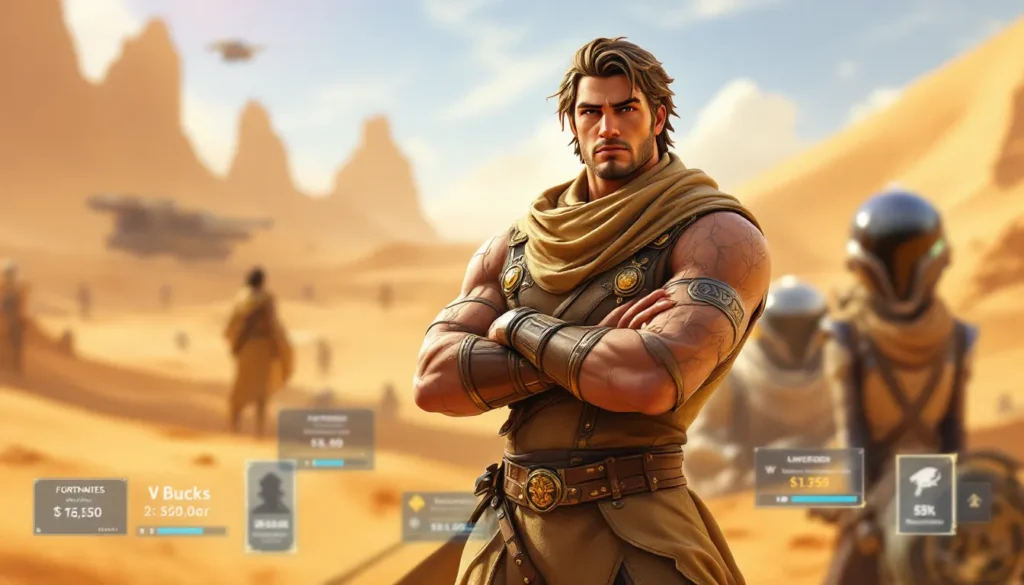
The Paul Atreides skin is the flagship cosmetic of this crossover. It features his iconic stillsuit design with the desert weathering and ornate details that fans recognize from the films. The skin includes two main style variants: his standard Arrakis appearance and an alternate outfit reflecting his later status in the series. Both styles are cleanly rigged and don’t obstruct vision in competitive play.
The pickaxe bundled with Paul’s skin is a crysknife, a foldable blade weapon that matches the Dune aesthetic. It’s compact, non-intrusive, and doesn’t produce excessive audio cues that’d tip off enemies to your position. The back bling pairs a desert-themed pack that doesn’t create additional hit-box concerns.
One key detail: Paul’s skin doesn’t feature any bulky shoulder armor or extreme proportions, making him viable for players who prefer slimmer silhouettes. The stillsuit’s tight design means you’re not sacrificing competitiveness for cosmetics.
Lady Jessica And Other Character Skins
The Lady Jessica skin brings a more elegant aesthetic to the crossover. Her outfit reflects her role as a noble with combat capability, featuring layered robes and a distinctive silhouette. The skin includes alt styles capturing different moments from her character arc, though both are equally competitive-viable.
Beyond Paul and Jessica, Fortnite released supporting character skins including Chani and other major Dune figures. Each skin maintains individual silhouettes so they don’t feel redundant when multiple players land in the same POI. The cosmetics tier is 1200 V-Bucks for standard skins, with bundle pricing available for multi-skin purchases.
The female character skins specifically maintain Fortnite’s standard proportions without exaggeration, meaning zero competitive disadvantage. Some skins in past collabs have featured bulky armor or impractical designs, these Dune cosmetics avoid that trap entirely.
Harvester And Vehicle Cosmetics
Epic introduced vehicle-specific cosmetics transforming your vehicles into Dune-themed equivalents. The Sandworm Harvester wrap for vehicles creates the visual effect of piloting a massive harvester across the map. This is pure cosmetic, no gameplay advantage, but the visual presence when rolling up to late-game zones is undeniably cool.
The Harvester wrap doesn’t obscure your vehicle’s actual collision hitbox or create visual glitches. Some vehicle wraps in the past have caused mild visibility issues for teammates: these are clean.
Gliders also received Dune variants, with cosmetics designed to reference the franchise’s transport methods. These are lower-priority purchases compared to skins, but they round out a complete Dune loadout if you’re committed to the theme.
Dune Weapons And Items In Battle Royale
Fortnite didn’t just drop cosmetics, they integrated actual Dune-themed weapons into Battle Royale loot pools during the event period. These weren’t gimmicks: several became legitimate meta considerations.
The Shuriken Launcher drew heavy inspiration from Dune’s ornate weaponry while functioning as a unique delivery mechanism. It fires proximity-detonating projectiles with a 2.5-second flight time before auto-detonating. Damage values sat at 85 body/110 headshot at launch, making it viable for mid-range engagements without breaking TTK expectations. The weapon had moderate drop-off, requiring some aim practice to master.
Another key drop was the Sonic Disruptor, a utility weapon that disrupted shield mechanics for short durations. It wasn’t a direct damage dealer but forced opponents to play reactively after being hit. The trade-off meant carrying it meant less raw DPS, so usage depended on playstyle. Comp players mostly skipped it in favor of traditional AR/SMG combos.
Spice-themed consumables were integration too. Spice Vials functioned as healing items granting temporary movement speed buffs (15% for 8 seconds). They occupied inventory space like shields but offered unique value for rotations and exit-fragging scenarios. Smart players leveraged the speed boost for aggressive final-circle plays.
Weapon availability fluctuated. During limited-time modes, loot pools featured these weapons at higher drop rates. In standard Battle Royale, they cycled in and out based on seasonal balance patches. By mid-2026, some had been vaulted to reduce item shop clutter, though they appeared in Creative mode and certain LTMs permanently.
Platform note: All weapons and consumables were available on PC, PS5, Xbox Series X
|
S, Nintendo Switch, and mobile platforms where Fortnite runs. Mobile versions had slightly adjusted spawn rates to account for frame-rate differences.
How To Obtain Dune Cosmetics
Acquiring Dune cosmetics required understanding Fortnite’s monetization structure. Epic offered multiple pathways depending on player preference and budget.
Battle Pass And Item Shop Strategy
The primary acquisition method was the Dune-themed Battle Pass during the crossover season. This pass cost 950 V-Bucks (roughly $9.50) and offered cosmetics at multiple tiers. Early pass tiers rewarded cosmetics immediately, you didn’t need to grind to tier 100 for everything.
Specific breakdown:
- Tier 1-20: Paul Atreides progressive cosmetic (unlocked in stages)
- Tier 35: Crysknife pickaxe variant
- Tier 50: Desert-themed loading screen and emote
- Tier 70: Lady Jessica alternate style unlock
- Tier 100: Mythic variant Paul Atreides skin with animated visual effects
Essentially, you could unlock quality cosmetics just by playing 1-2 matches daily. The grind to tier 100 took roughly 40-50 hours of casual play for the average player.
The Item Shop rotated Dune cosmetics in 24-hour cycles. Not all cosmetics appeared in the battle pass, exclusive Item Shop cosmetics required direct V-Bucks purchase. Bundle pricing (2-3 cosmetics bundled at discounted rates) appeared roughly every 3-4 days.
Timing mattered. Epic typically discounted cosmetics 6-8 weeks after their initial release. Patient players could save V-Bucks by waiting, though supply anxiety sometimes pushed players to impulse-buy. The safest approach: purchase battle pass immediately, wait on Item Shop cosmetics unless you specifically wanted them week-one.
Challenges And Seasonal Rewards
Beyond the pass, completion challenges awarded cosmetic pieces. These weren’t just XP grinds, they provided actual cosmetic unlocks.
Challenge examples from the Dune season:
- “Deal 500 damage with Dune-themed weapons” → Cosmetic weapon wrap
- “Complete 10 matches landing in Dune POIs” → Loading screen variant
- “Survive 5 final circles without taking damage” → Emote unlock
Seasonal rewards tracked throughout the 10-week season. Hitting specific milestones (25%, 50%, 75% challenge completion) unlocked cosmetic variants and alternate styles for existing skins.
The challenge structure was balanced, no single challenge required sweaty competitive performance. Casuals and competitive players both earned rewards through reasonable engagement.
Dune-Themed Locations And Map Changes
Fortnite’s battle royale map received significant alterations during the Dune crossover period. Epic didn’t just add cosmetics: they reshaped portions of the island to reflect the Dune universe.
The primary addition was Arrakis Station, a new POI replacing the existing desert biome area. This wasn’t a tiny landmark, it was a fully-developed named location comparable in size to medium-tier POIs like Greasy Grove. The architecture featured Dune-inspired buildings with practical loot distribution:
- Harvester Compound: Central structure with legendary loot spawns (typically 2-3 guaranteed legendary floor loot)
- Spice Refinery: Medium-tier loot zone with shield consumables and utility items
- Sand Vault: Underground tunnels offering shield healing items and crafting materials
The POI included vertical gameplay with multi-story buildings, rooftop encounters, and underground tunneling. This made it viable for both aggressive early-game rotations and late-game positioning.
Beyond Arrakis Station, Epic applied thematic recoloring to existing locations. Rock textures shifted to sand, building exteriors adopted desert color palettes, and vegetation was selectively removed to match Dune’s harsh aesthetic. This didn’t affect gameplay, just visual theming, but immersion increased noticeably.
Sandstorm events appeared during match rotations. These functioned similarly to the game’s storm mechanics but with unique visual effects. The sandstorm obscured vision slightly more than standard storm, forcing players into tighter rotations. It was a pure RNG mechanic, so some matches felt starkly different depending on storm RNG.
The map changes persisted through the crossover period and gradually reverted as the season ended. By late 2026, Arrakis Station remained as a named location, but the Dune-specific aesthetic gradually blended back toward standard Fortnite theming.
Limited-Time Modes And Events
The Dune crossover introduced exclusive limited-time modes that ran for 2-3 week windows throughout the season. These weren’t afterthoughts, they offered unique gameplay mechanics unavailable in standard BR.
Spice Rush was the flagship LTM. This 50v50 mode split players into Harvesters vs. Fremen. The Harvesters’ objective was to collect spice deposits scattered across the map and extract them via dropship. The Fremen’s goal was to prevent extraction through combat and environmental disruption.
The mode’s unique mechanic: spice collection provided temporary stat boosts. Players carrying spice gained:
- +20% movement speed
- +15 shield regeneration per second
- Temporary immunity to environmental damage
This created dynamic risk-reward scenarios. Do you camp spice zones for easy eliminations, or do you contest harvested spice from stronger players? Smart team coordination separated competent players from fraggers.
Sandstorm Survival was a time-limited solo mode where the storm moved unpredictably, mimicking actual sandstorm behavior. Players couldn’t see storm predictions beyond 30 seconds in advance. This forced constant adaptation rather than predictable late-game positioning. The mode favored awareness and quick rotation calls over pure mechanical skill.
Herald’s Challenge was a squad-based objective mode where teams completed Dune-themed challenges (harvest spice, defeat environmental bosses, escape sandstorm gauntlets) to earn cosmetic rewards and exclusive emotes.
These LTMs rotated in 3-week cycles. A typical season featured 5-6 distinct Dune LTMs alongside standard game modes. Players could earn cosmetics and cosmetic variants exclusively through LTM progression, incentivizing participation beyond casual play.
All LTMs were available across all platforms. Console players didn’t experience degraded performance or reduced cosmetic availability compared to PC players.
Tips For Using Dune Skins And Cosmetics Effectively
Cosmetics are aesthetics first, but some competitive advantages exist if you understand silhouettes and visual noise.
Competitive Play Considerations
For ranked and competitive matches, Paul Atreides is the optimal choice. His slim stillsuit design creates the smallest visual profile. In competitive shooters, visual silhouette matters, bulkier skins make you slightly easier to track, especially at range. Paul’s compact design means opponents have less surface area to target.
The Dune cosmetics don’t feature bright, high-contrast colors that make you stand out in foliage. Instead, they use earth tones (sand, tan, desert browns) that blend naturally into Fortnite’s environment. Landing at Arrakis Station? The cosmetics’ desert theming actually provides mild camouflage.
Audio cues matter too. Some cosmetics have bulky armor that creates excessive footstep sounds. The Dune skins use lightweight stillsuit material, producing standard footstep audio without distraction. You won’t give away your position through louder cosmetic sounds.
Pickaxe choice impacts early-game audio awareness. The crysknife is compact and produces sharp, brief harvesting sounds. Compared to other cosmetic pickaxes (some sound like explosions), it communicates resource gathering without alerting distant enemies to your presence.
For arena and tournament play, the Paul Atreides skin was widely adopted among competitive players. It’s not pay-to-win, but it’s optimal, there’s a reason you’ll see it at major esports events.
Aesthetics Vs. Functionality
Here’s the honest take: cosmetics don’t determine matches. The Dune skins are gorgeous, but they don’t make you better. They make you feel better, which has psychological value.
That said, some cosmetic choices create genuine friction. Overly bulky back blings can partially obscure your weapon in ADS (aim-down-sights), creating a slight visibility handicap. The Dune cosmetics’ back blings are minimalist, so you’ll see your gun clearly when scoped.
Challenge yourself: use whatever cosmetics you enjoy. If the Dune skins make you happy, you’ll play more comfortably and confidently. Confidence translates to better decision-making and gunplay. The best cosmetic is whichever one makes you want to queue the next match.
That said, if you’re pushing for rank progression or tournament qualification, prioritize cosmetic efficiency. Use Paul Atreides or other slim-profile skins. It’s a marginal advantage, but marginal advantages compound over dozens of matches.
What Players Are Saying About Dune In Fortnite
Community reception was overwhelmingly positive, though with notable caveats.
Community Reception And Reviews
Content creators praised the crossover’s authenticity. Unlike some collabs that feel tacked-on, the Dune event integrated meaningfully into Fortnite’s gameplay. YouTubers and Twitch streamers highlighted the cosmetics’ quality, with many noting the skins stood among Fortnite’s best character cosmetics aesthetically.
Competitive players appreciated the balance. No Dune weapon felt overpowered, they filled specific niches without breaking the meta. The Shuriken Launcher saw adoption in zone-control scenarios, but it didn’t replace fundamental meta weapons. Players respected the restraint.
Casual players loved the immersion. The thematic locations and sandstorm events made matches feel distinct. Arrakis Station became a legitimate hot-drop location with good loot distribution, not just a tourist destination.
Negative feedback centered on cosmetic pricing. 1200 V-Bucks (roughly $12) per skin felt steep to some players, though this aligns with Fortnite’s standard legendary pricing. Bundle discounts helped offset this, but early adopters paid full price.
Mobile players noted frame-rate drops in Arrakis Station during early implementation. Epic released optimizations in a mid-season patch that largely resolved these issues, though some lower-end Android devices still experienced stuttering in dense combat.
The battle pass received praise for value. Earning Paul Atreides and cosmetics through natural gameplay felt fair, no extreme grinding required.
Trading And Secondary Market Value
Fortnite cosmetics don’t have an official trading system, but secondary markets exist where rare/exclusive cosmetics trade at premiums.
Dune cosmetics held solid secondary market value, though not at the level of ultra-rare legacy cosmetics. A full Dune cosmetics set (multiple skins, pickaxes, wraps) typically added $50-100 in secondary market value to an account. This reflected the cosmetics’ quality and popularity rather than artificial scarcity.
The Mythic Paul Atreides variant (tier 100 battle pass exclusive) held the most value. Since you can only obtain it through battle pass completion, it carries permanence value, new accounts can never unlock it. Secondary markets priced it at roughly $30-50 alone.
It’s worth noting: account trading violates Fortnite’s terms of service. This market operates in gray-zone territory. Buy-sell-trade at your own risk about account security and policy violations.
Future Dune Collaborations And What To Expect
Epic and the Dune IP holders have strong incentive to continue collaborations. Dune: Part Three is confirmed in development with theatrical release expected 2027-2028. Industry speculation suggests Fortnite will integrate another Dune event coinciding with the film’s marketing cycle.
What might we see? New character skins feel likely, Fortnite will probably release cosmetics featuring other major Dune characters not included in the 2025-2026 crossover. Feyd-Rautha, Emperor characters, and potentially minor characters from expanded Dune media could appear.
Weapon-wise, Epic might introduce more exotic Dune-universe tools. The initial event focused on harvesters and Fremen-inspired weapons, but Dune’s universe features advanced technology that could translate into gameplay mechanics. Expect creativity here.
The map integration might expand. Rather than a single POI, a future crossover could introduce a multi-zone desert biome capturing different regions of Arrakis. This would require more significant development investment, but it’s entirely feasible given Fortnite’s resources.
LTM design could become more narrative-driven. Future events might feature story-based challenges reflecting Dune’s plot, adding narrative depth beyond generic objectives.
Timing-wise, expect announcements in late 2027 or early 2028 as Dune: Part Three’s promotional cycle ramps up. Epic typically announces major collaborations 2-4 weeks before launch, so mark your calendars for mid-2027 if you want to prepare V-Bucks in advance.
One caveat: all this is speculation based on industry patterns. Epic hasn’t officially confirmed future Dune events. Plan accordingly, but don’t expect guarantees.
Conclusion
The Dune Fortnite crossover delivered on authentic IP integration and meaningful gameplay additions. The cosmetics are genuinely well-designed, the weapons felt balanced, and the LTMs provided fresh gameplay without breaking core mechanics.
If you’re on the fence about investing V-Bucks, the battle pass offers solid value. Tier 100 costs roughly 10 hours of casual gameplay and rewards multiple cosmetics. Commit or skip based on whether Dune resonates with you, there’s no FOMO pressure since cosmetics remain purchasable long after seasonal rotation.
For competitive players, Paul Atreides is worth picking up if you main slimmer cosmetic silhouettes. For casuals, grab whatever makes you happy. For collectors, the full cosmetics lineup represents some of Fortnite’s highest-quality crossover work.
The crossover proved successful enough that future Dune events seem inevitable. If you missed this window, anticipate another opportunity when Dune: Part Three releases. Until then, players who invested in these cosmetics own pieces of Fortnite history, rare, authentic Dune representation that required genuine IP collaboration rather than lazy licensing.


